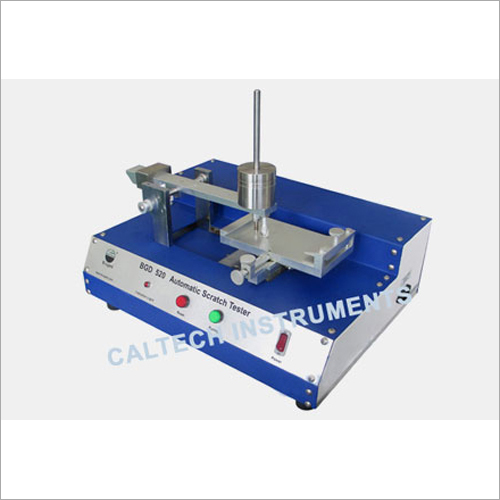
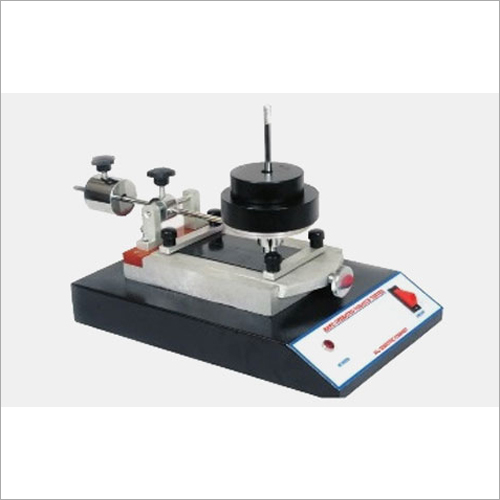
Automatic Scratch Tester About
Technical Specification.
- Motor: 60W 220V 50HZ
- Mass of weights: 50g-2500g
- Diameter of an indentor with a half-spherical end: 1mm
- Max Panel size: 1001501.6mm (0.3 mm coating|)
- Overall dimensions: 380300180mm
- Weight: 25kg
Advanced Control and Measurement PrecisionThe testers microprocessor-based control offers precise adjustment of stroke length and scratch speed, making it suitable for a variety of standard-compliant tests. Its piezoelectric sensor measures force with an accuracy of 0.5 N, ensuring reliable results for both single and multiple samples. This versatility is further enhanced by comprehensive overload protection and a safety interlock for secure operation.
Versatile Sample CompatibilityEquipped with a universal adjustable fixture, the instrument can handle a broad range of sample shapes and sizes. It is ideal for evaluating paints, coatings, and plastics under controlled conditions. The device suits laboratories, manufacturers, and research facilities needing repeatable and standardized surface adhesion assessments.
Efficient Data Management and ConnectivityStore up to 1000 test results in the built-in internal memory for easy retrieval and analysis. Optional USB/RS232 connectivity allows seamless data transfer and integration with laboratory information systems, supporting robust documentation and process traceability.
FAQs of Automatic Scratch Tester:
Q: How does the Automatic Scratch Tester operate for surface analysis?
A: The tester uses a microprocessor-controlled mechanism to apply adjustable loads on sample surfaces. A 1 mm stylus tip moves with customizable stroke lengths and speeds, simulating real-world abrasion while piezoelectric sensors record precise force measurements.
Q: What types of samples can be tested with this device?
A: Thanks to its universal adjustable fixture, the Automatic Scratch Tester accommodates a wide variety of shapes and materials, including paints, coatings, and plastics, ensuring compatibility with most laboratory and industrial requirements.
Q: When should operators consider using the tester in their processes?
A: The device excels during quality assurance, research, or development phases when assessing the adhesion, strength, or resistance of surface coatings under consistent and repeatable conditions.
Q: Where is the Automatic Scratch Tester commonly used?
A: The instrument is widely adopted in industrial labs, academic research facilities, and manufacturing plants focused on coatings and plastics. It is suitable for dealer, distributor, exporter, importer, manufacturer, producer, service provider, and supplier roles across India.
Q: What is the process for conducting a scratch test using this equipment?
A: Place the sample in the adjustable holder, select the desired stroke length and speed, and set the load via the LCD display. Initiate the test, monitor real-time feedback, and save results to the internal memory or transfer them via USB/RS232 if required.
Q: How does the testers compliance with ASTM and ISO standards benefit users?
A: Meeting ASTM and ISO standards ensures the validity and international acceptance of test results, promoting consistent product quality and satisfying regulatory or client requirements efficiently.
Q: What safety features are included in the Automatic Scratch Tester?
A: The device incorporates overload protection and a safety interlock, minimizing operational risks and protecting both users and samples during high-force tests.








 Send Inquiry


 Send Inquiry


 English
 Spanish
 French
 German
 Italian
 Chinese (Simplified)
 Japanese
 Korean
 Arabic
 Portuguese