Rotary Abrasion Tester About
Rotary Abrasion Tester
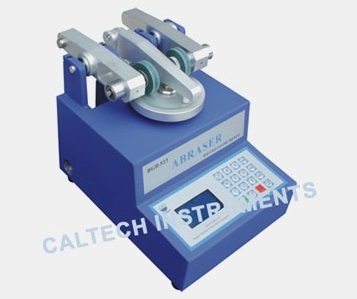
The principle of abrasion derived by the test sample, turning on a vertical axis, against the sliding rotation of 2 Abrading Wheels. The wheels are driven by the sample in opposite directions about a horizontal axis displaced tangentially from the axis of the sample. One of the abrading wheel rubs the specimen outward toward the periphery and the other wheel, inward to the centre. The area of abrasion from a pattern of crossed arcs of about 30sq.cm.
The degree of abrasion for the specimen also depends on the load force500g, 750g or 1000g on each armbeing acted onto the axial of the 2Arms,which has a load pressure of 250g
It confirms to DIN 52347 53109 53754 53799
ISO 5470, 9352, 3573, 4586-2,7784-2
ASTM C217, D1044, D3389, D4060, D5342
Exceptional Test Precision and VersatilityDesigned with a high precision synchronous motor and digital display, this tester ensures 1% accuracy in wear measurements across various specimen types. The adjustable test loads, multiple compatible wheel types, and programmable cycles provide versatility, catering to the testing needs of industries dealing with coatings, textiles, plastics, and more.
Safety and Convenience PrioritizedThe equipment incorporates a robust safety interlock on the door, overload and short-circuit protection, and an easy-to-clean, powder-coated finish. A comprehensive accessory kit, low maintenance design, and digital interface streamline the user experience and promote safe, reliable operation in laboratory or factory settings.
FAQs of Rotary Abrasion Tester:
Q: How does the Rotary Abrasion Tester with Drive Mechanism operate?
A: The tester uses a high precision synchronous motor to rotate the abrasion wheel against the mounted specimen at a fixed speed of 72 rpm. Users can select between supplied standard weights (5N or 10N), set the required number of cycles (19999), and utilize the digital counter to monitor test progress. The programmable timer ensures controlled, repeatable operation.
Q: What sample types and industries benefit most from this tester?
A: This tester is suitable for testing textiles, leather, plastics, paints, and coatings, making it ideal for quality control and research in industries such as automotive, apparel, packaging, and surface finishing. Its variable measurement range accommodates specimens up to 10 mm thick.
Q: When is calibration or maintenance required for the tester?
A: Regular calibration using the included calibration tool is recommended before critical test routines or after extended periods of non-use. Due to its low-maintenance design, periodic cleaning (particularly of the sample holder and abrasion wheel area) will keep the machine performing optimally.
Q: Where should the Rotary Abrasion Tester be installed for optimal performance?
A: Install the tester on a stable, level surface in an environment with ambient temperatures between 5C and 40C and humidity up to 85% RH. Ensure proximity to an AC 220V, 50 Hz power supply. The unit is compact enough for most laboratories or quality control rooms.
Q: What is the process for changing the abrasion wheels and weights?
A: Simply open the safety-interlocked door, remove the sample holder, and slide out the abrasion wheel. Replace with a compatible wheel type (CS-10, H-18, or H-22) as required. Standard weights are easy to mount on the holder to adjust test loads without special tools.
Q: How does the safety interlock function enhance user protection?
A: The door safety interlock prevents the tester from operating if the access door is open, significantly reducing the risk of accidental contact with moving parts during testing or setup.








 Send Inquiry


 Send Inquiry


 English
 Spanish
 French
 German
 Italian
 Chinese (Simplified)
 Japanese
 Korean
 Arabic
 Portuguese