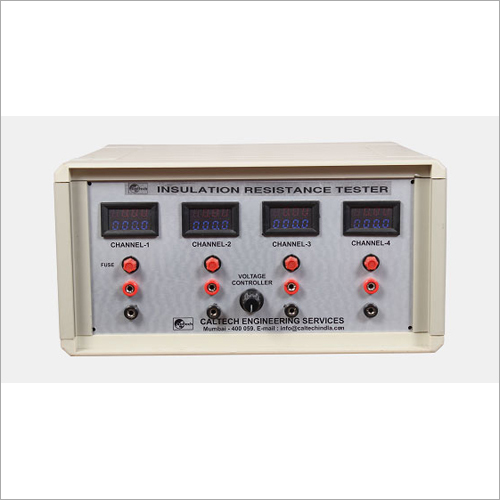
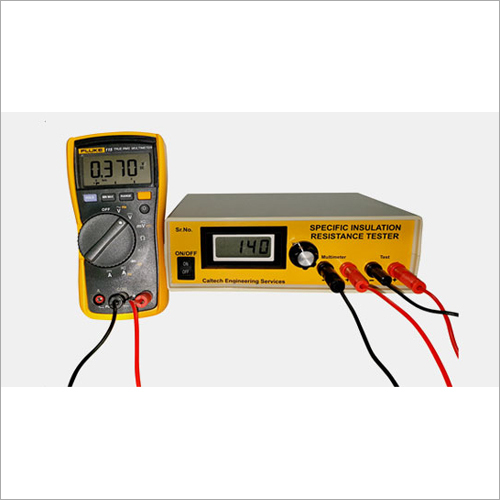
About Specific Electrical Insulation Resistance Tester
Technical specification
Model | SISR-05 |
Power | 230V AC, 10 %, 50~60 Hz |
Output Voltage | 10~60 1 Volts via Test voltage controller |
Output Current | 0.001 ~ 1.000 amp |
Metering | LCD Display |
Accuracy | 1% |
Protection | Against Short Circuit |
Efficient and Reliable Insulation TestingEngineered to deliver precise measurements, this tester is suitable for testing the insulation resistance of electrical systems up to 1000 M. Conforming to IEC 61010, it ensures user safety and reliability in professional environments. Its compact and lightweight build makes it easily portable for electricians, contractors, and maintenance engineers.
Versatile Power and Usage OptionsThis insulation tester offers flexible operation, running either on a 9V battery or standard 230V AC power supply. Its manual operating mode and easy-to-handle form factor allow convenient measurements in various settings, from field work to laboratory testing. Overload and short circuit protection safeguard both users and equipment during inspections.
FAQs of Specific Electrical Insulation Resistance Tester:
Q: How do I use the insulation resistance tester for measurements?
A: To use the tester, connect the test leads to the equipment under inspection, select the required range, and press the test button. The analog needle display will show the insulation resistance value, which you can then read and record.
Q: What are the benefits of using this specific insulation resistance tester?
A: This tester offers high accuracy (2%), overload and short circuit protection, and a wide measurement range from 1 M to 1000 M. Its portable design and dual power options make it versatile and safe for field or in-shop use.
Q: When should I perform insulation resistance testing with this device?
A: Use this tester during routine maintenance, installation, or troubleshooting of electrical wiring and equipment to ensure insulation integrity and prevent potential faults or hazards.
Q: Where is this insulation resistance tester most commonly used?
A: This device is ideal for use in industrial plants, commercial buildings, and electrical service workshops across India. Its portable design supports on-site and in-field diagnostics.
Q: What is the process for switching between battery and AC power operation?
A: Simply insert a 6F22 9V battery for portable, non-mains use, or plug the tester into a 230V AC power source when available. The device is designed to automatically work with the power source provided.
Q: What safety features does this insulation tester provide?
A: The tester conforms to IEC 61010 safety standards and is equipped with overload and short circuit protection, ensuring safe operation for the user and the device during testing.
Q: Can this tester be used in high-humidity environments?
A: Yes, the insulation tester can operate efficiently in conditions with humidity up to 80% RH and temperatures between 0C and 40C, making it suitable for various climates across India.








 Send Inquiry


 Send Inquiry


 English
 Spanish
 French
 German
 Italian
 Chinese (Simplified)
 Japanese
 Korean
 Arabic
 Portuguese