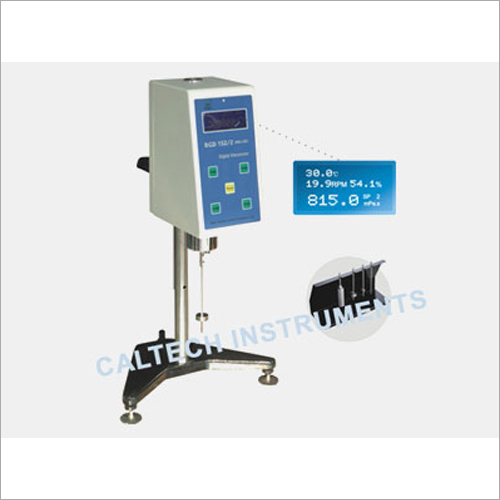
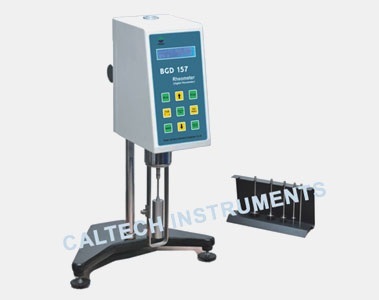
About Digital Rotary Viscometer
Technical specification
- Rotors to be used to measure four rotors of NO.1-4
- Rotate speed 6r/min,12r/min,30r/min,60r/min-For BGD 152/1 0.3 r/min , 0.6 r/min,1.5 r/min,3r/min, 6r/min,12r/min,30r/min,60r/minFor BGD 152/2
- Meterage error 5%Newtonian fluids
- Electrical power 220V/50Hz
- Weight10Kg
- Dimensions 308mm300mm450mm. LWH
- Others Direct Digital displayrotate speed, the type of rotors, results
Advanced Measurement CapabilitiesThis digital rotary viscometer covers an extensive viscosity range, providing accurate results for both thin and highly viscous liquids. Its microprocessor-controlled system guarantees rapid stabilization within two minutes, and the included spindle selection accommodates diverse sample types. A high-resolution, backlit LCD ensures measurements are easily read in any laboratory setting.
User-Friendly Operation & DesignEquipped for continuous operation, this viscometers manual or automatic calibration abilities facilitate consistent performance. Its bench-top design with compact dimensions and manageable weight makes it ideal for most lab benches. Overload protection safeguards the equipment, while the sturdy stainless steel and ABS build ensure durability and reliability.
Versatile Data Handling & ComplianceWith built-in RS232 connectivity, users can effortlessly transfer data to their PCs for detailed analysis or record-keeping. The instrument complies with ISO/CE standards, meeting international quality and safety benchmarks. The inclusion of calibration fluids and a carrying case offers convenience and portability for professionals across industries.
FAQs of Digital Rotary Viscometer:
Q: How does the digital rotary viscometer measure viscosity?
A: The digital rotary viscometer utilizes a rotary sensor and four interchangeable spindles to measure the resistance of a liquid as the spindle rotates at selectable speeds. The device calculates the viscosity by interpreting the torque required to maintain constant spindle rotation within the sample.
Q: What types of liquids can be tested with this viscometer?
A: This viscometer is suitable for a variety of industrial and laboratory fluids, accommodating viscosities in the range of 1 to 2,000,000 mPas. Its versatility makes it ideal for testing oils, paints, adhesives, pharmaceutical solutions, and other liquid media.
Q: When should I perform calibration, and is it manual or automatic?
A: Calibration can be performed as part of routine maintenance or whenever you notice measurement inconsistencies. This model supports both manual and automatic calibration, allowing for flexibility according to your standard operating procedures.
Q: Where can I use this viscometer?
A: Designed primarily for bench-top use, this viscometer can be deployed in industrial labs, research institutes, quality control departments, and production environments. Its compact size and included carrying case make it practical for varied locations.
Q: What is the process to transfer measurement data to a computer?
A: Data transfer is achieved through the RS232 serial port connectivity. After connecting the viscometer to a PC, you can use compatible software for seamless data acquisition, storage, and analysis.
Q: How does the device ensure accurate and safe measurements?
A: The viscometer maintains accuracy within 1% of full scale, backed by a microprocessor for precise control and fast stabilization. Overload protection and compliance with ISO/CE standards further enhance measurement safety and reliability.
Q: What are the main benefits of using this viscometer in the laboratory?
A: Key advantages include broad viscosity measurement range, rapid stabilization, easy calibration options, reliable data output, and international compliance. Its user-friendly interface, durable construction, and wide application make it a valuable asset for professionals dealing with quality assessments of liquid materials.








 Send Inquiry


 Send Inquiry


 English
 Spanish
 French
 German
 Italian
 Chinese (Simplified)
 Japanese
 Korean
 Arabic
 Portuguese