About Indentation Test - High Temp
Technical specification
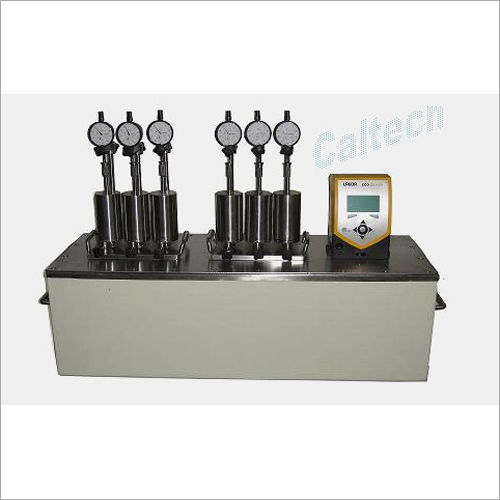
Construction | Stainless Steel |
Size of Bath | 585 x 365 x 290mm Approx |
Control Panel | Automatic Control Panel |
Heater | 1500 Watt |
Thermostat | Electronic controlled Thermostat with EC confirmity |
Display | Monochrome LCD display ( Ambient to 90 deg cent) |
Sensor | PT-100 |
Timer | 1 to 9999 mins (0.01 to 166 Hours) |
Std Weights | 2.250 Kgs Stainless Steel |
Indenter | 0.250 Kgs Indentor of 1.8mm dia |
Support Stand | For dial gauges with extra length (06 Nos) |
Dial Gauge | 0 to 10mm lc 0.010mm (06 Nos.) |
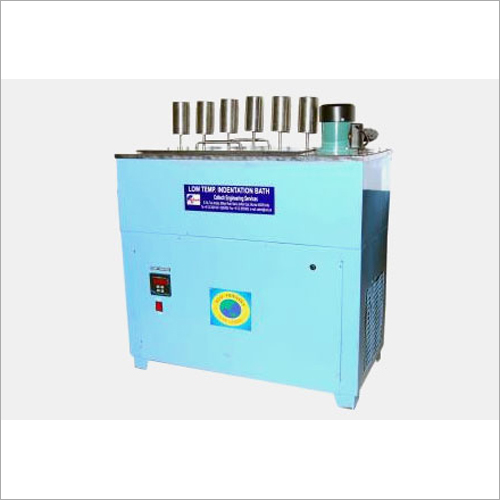
Test Bench | Two test bench consisting 6 samples testing facilities |
Stirrer | Integrated pump for liquid / water |
Advanced High-Temperature Indentation TestingThis device supports rigorous analysis of plastics under high-temperature conditions, ensuring reliability according to internationally recognized standards. Its precise measurement range and rapid heat-up time streamline laboratory operations, while the digital display enhances usability. Engineered for the Indian market, it suits a wide variety of laboratory and industrial environments, offering both accuracy and flexibility for various sample sizes.
Safety and Precision CombinedWith integrated thermal overload protection and a robust stainless steel body, this tester prioritizes operator safety even during extended high-temperature testing. The thermocouple and displacement sensors deliver high-precision readings, and the devices low power consumption contributes to overall operational efficiency.
FAQs of Indentation Test - High Temp:
Q: How does the electric heating element maintain precise temperatures during indentation testing?
A: The systems electric heating element ensures consistent temperature control up to 1000C by utilizing a thermocouple sensor and displacement sensor arrangement. This setup provides stable heat to the sample holder throughout the test, maintaining adherence to the specified standards for reliable indentation measurement.
Q: What is the process for conducting an indentation test on plastics with this device?
A: The process begins by placing a prepared plastic sample in the heat-resistant holder. After setting the desired temperature, the system heats up within 15 minutes. Once the test temperature stabilizes, a 100g standard weight is applied. Indentation depth is measured using the digital display as per IS 4984 / ASTM D 1525 specifications.
Q: When should the Indentation Test - High Temp system be used in quality control?
A: This system should be employed during the evaluation phase of material selection, regular quality control checks, and research or validation when testing the thermal and mechanical deformation resistance of plastics, especially those designated for use in high-temperature environments.
Q: Where can this indentation testing equipment be installed for optimal performance?
A: Being a table-top unit, it is best placed in a well-ventilated laboratory or production testing area with access to 230 V AC, 50 Hz power. Ensure the surrounding conditions do not exceed 90% non-condensing humidity and that ambient pressure is maintained for accurate operation.
Q: What are the main benefits of using this high-temperature indentation tester?
A: Key benefits include precise, repeatable indentation measurements at elevated temperatures, fast test cycles, enhanced operator safety features, and convenient digital data output for analysis or record-keeping, supporting productivity and compliance with global testing standards.
Q: How is data from the indentation test exported or connected for external analysis?
A: The tester features USB/data output connectivity, allowing seamless exporting of measurement results for further analysis or integration into laboratory information management systems.
Q: Can this system accommodate different sample sizes, and is capacity customization available?
A: Yes, the testers capacity can be tailored as per specific sample size requirements. The measurement range follows industry norms, but customization options are available by contacting the manufacturer.








 Send Inquiry


 Send Inquiry


 English
 Spanish
 French
 German
 Italian
 Chinese (Simplified)
 Japanese
 Korean
 Arabic
 Portuguese