About Magnetic Surface Thermometer
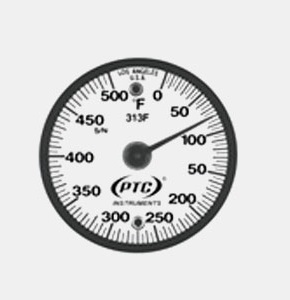
Caltech India offers Magnetic Surface Thermometer. Dual Magnet Mount Surface Thermometers are specifically designed to measure surface temperature. Used on any horizontal surface or held magnetically to any magnetic surface. These instruments feature two high temperature alnico magnets that act as the thermometers base and hold the instrument in place on magnetic surfaces. The bimetallic sensor is located in a draft shield and is in virtual thermal contact with the surface to be measured. This gives the instrument a relatively quick response time. The thermometer reaches sensing equilibrium (stability) within three minutes. Single or max-min ancillary hands are available for this instrument as an option.
Designed for applications such as: hot plates; griddles; die-cast dies; foundry core boxes; annealing ovens; weld preheats; motors, generators, and engines; bearings; boilers, tanks etc
Effortless Mounting and DurabilityDesigned for straightforward installation, the thermometer uses a magnetic base to ensure secure, direct attachment to metallic surfaces. Its robust stainless steel case with a glass window enhances resistance to environmental wear and tear, making it suitable for both indoor and outdoor use. The IP42 protection guarantees the device can withstand solid objects larger than 1mm and dripping water, maintaining reliability in demanding settings.
Precision Measurement Without External PowerOperating mechanically via a bimetallic strip sensor, the thermometer requires no external power or connectivity. Factory calibration ensures consistent accuracy within 2% of full scale. The analog dial display, marked with 1C intervals, provides immediate, clear temperature readingsperfect for rapid monitoring needs in industrial or commercial environments.
Broad Utility Across IndustriesServing as a dependable instrument for dealers, distributors, exporters, manufacturers, and service providers, this thermometer is suited for single-point measurements on various metallic surfaces. Its quick response time and user-friendly mounting facilitate efficient monitoring for temperature-critical processes in manufacturing, trading, and maintenance sectors.
FAQs of Magnetic Surface Thermometer:
Q: How do I mount the Magnetic Surface Thermometer onto a metal surface?
A: Simply attach the device directly to the desired metallic surface using its integrated magnetic base. The magnet ensures secure contact and stable positioning for accurate measurements.
Q: What environments is this thermometer suitable for?
A: The thermometer works reliably in both indoor and outdoor settings, tolerating up to 95% relative humidity (non-condensing). Its IP42 protection rating enables use in environments where protection from solid particles and dripping water is necessary.
Q: When can I expect to read accurate measurements after placing the thermometer?
A: You can expect to obtain accurate temperature readings approximately one minute after attachment, allowing the device to reach thermal equilibrium with the surface.
Q: Where should this thermometer be used for optimal results?
A: For optimal performance, use the thermometer on clean, metallic surfaces where direct contact is possiblecommonly in industrial, manufacturing, or HVAC applications.
Q: What maintenance or calibration is required for this device?
A: No ongoing calibration or maintenance is needed, as the thermometer is factory-calibrated and user non-adjustable. Routine cleaning of the glass window and magnetic base is recommended.
Q: What are the benefits of using a mechanical, analog thermometer like this?
A: Mechanical analog thermometers require no power supply, offer robust durability, and provide immediate visual readings. With a clear analog dial and reliable factory calibration, they minimize operational complexity and reduce long-term costs.
Q: How can service providers and industrial users leverage this thermometer in their operations?
A: Service providers and industrial users can employ the thermometer for quick, single-point temperature checks on equipment and surfaces, enabling rapid and cost-effective monitoring during maintenance and process verification tasks.








 Send Inquiry


 Send Inquiry


 English
 Spanish
 French
 German
 Italian
 Chinese (Simplified)
 Japanese
 Korean
 Arabic
 Portuguese