About Multi-Mode Ultrasonic Thickness Gauge
Technical Specification
Model | MT-660 |
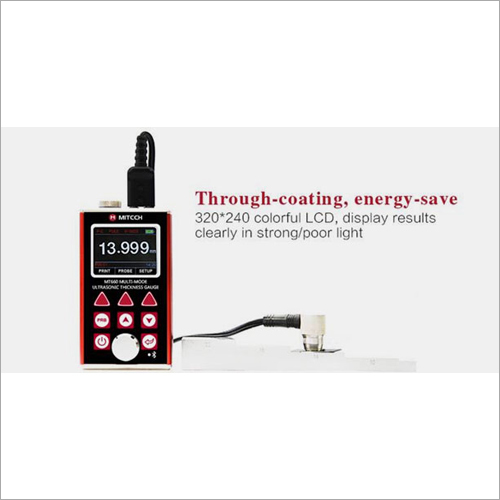
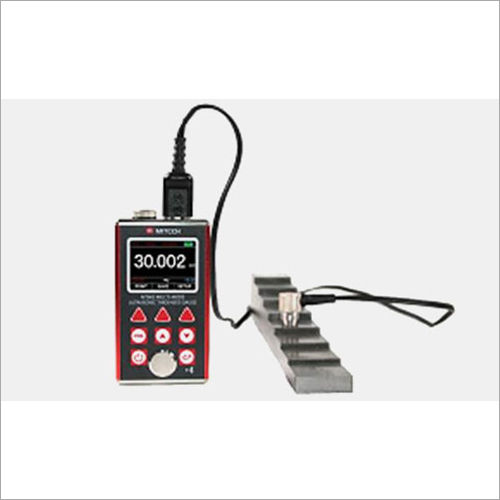
Display | 320240 TFT color LCD screen, adjustable backlight brightness |
Measuring Range | Two Working Modes: Pulse-Echo mode: (0.65600)mm (in Steel). Echo-Echo mode: (3100)mm |
Sound Velocity Range | 1000~9999 m/s |
Resolution | 0.1mm/0.01mm/0.001mm switchable |
Accuracy | (0.04mm (10mm): 0.4%H(>10mm) |
Calibration | Zero Point Calibration, Two Point Calibration |
Working Modes | Single Point Measurement, scan model measurement min/max measurement, differential measurement |
Units | Metric / English unit selectable |
Memory | Memory upto 100 files (upto 100 values for each file) of stored value |
Communication Interface | Support Bluetooth and USB2.0 communication, the host program can be uploaded online |
Data Printing | Capable of measuring Standard prtable Bluetooth thermal printer to print the measurement report |
Power Supply | Two AA size, 1.5 volt alkaline batteries. 100 hours typical operating time (EL backlight off) |
Automatic | It has auto screen standby, auto sleep, auto shutdown and other power saving functions. |
Material | Aluminium magnesium Alloy |
Dimension | 120 x 67 x 31 mm |
Net Weight | 317 g |
Advanced Measurement Modes for Multiple ApplicationsSwitch easily between Echo-Echo (E-E) and Pulse-Echo (P-E) modes to suit a variety of inspection requirements, allowing users to measure through coatings or directly on the base material. This flexibility ensures accurate readings on metals, plastics, ceramics, glass, and other ultrasonically conductive materials.
Robust Design for Enhanced DurabilityBuilt with an ABS engineering plastic housing and IP54 splash proof protection, this thickness gauge is designed to withstand demanding industrial conditions. The compact, lightweight build and carrying case make it convenient for fieldwork or daily use across various environments.
Comprehensive Data Management and ConnectivityCapture and store up to 500 readings with onboard memory, and utilize the USB or RS232 interface for seamless data transfer. Whether for manufacturing, quality assurance, or research, the gauges data output options enhance productivity and record-keeping.
FAQs of Multi-Mode Ultrasonic Thickness Gauge:
Q: How do I calibrate the Multi-Mode Ultrasonic Thickness Gauge for accurate measurements?
A: Calibration is straightforward with the options for 1-point, 2-point, or known thickness calibration methods. Use the provided calibration block and follow the instruction manual to ensure measurements are precise and reliable before use on your specific material.
Q: What materials can be measured with this ultrasonic thickness gauge?
A: This device can accurately measure a broad range of materials including metals, plastics, ceramics, glass, and most ultrasonic conductive materials, making it suitable for various industrial applications.
Q: When should I use Echo-Echo (E-E) versus Pulse-Echo (P-E) modes?
A: Use Echo-Echo (E-E) mode when you need to measure material thickness through coatings, paint, or layers. Pulse-Echo (P-E) is ideal for direct measurements on uncoated surfaces or where coatings are not present.
Q: What is the process for exporting data from the device?
A: You can export stored data using either the USB or RS232 interfaces. Simply connect the gauge to your computer or compatible device and follow the instructions for data transfer included in the manual.
Q: Where is this ultrasonic thickness gauge ideal to use?
A: It is suitable for use in manufacturing plants, quality control laboratories, field inspection sites, and anywhere material thickness measurements of metals, plastics, ceramics, or glass are required.
Q: How does the thickness alarm function benefit my workflow?
A: The high/low thickness alarm feature alerts you when measurements exceed specified limits, helping ensure product quality and process consistency without constant monitoring.
Q: What advantages do the auto power-off and long battery life features offer?
A: With auto power-off after 5 minutes of inactivity and up to 100 hours of battery life (with the backlight off), the gauge conserves energy and reduces the frequency of battery replacements, supporting extended field operations.








 Send Inquiry


 Send Inquiry


 English
 Spanish
 French
 German
 Italian
 Chinese (Simplified)
 Japanese
 Korean
 Arabic
 Portuguese